On Wednesday, 11 March 2026, Iceberg Plus, the MetaVET Project coordinator successfully hosted the soft launch of the Virtual Reality (VR) training platform in Brașov, marking an important milestone for the project and a great leap in advancing digital and immersive learning for Technical and Vocational Education and Training (TVET). The event welcomed representatives from several important regional stakeholders including Chamber of Commerce and Industry Brașov, MultiTech Romania as Universal Robots representatives, and the Fundatia Comunitara Brasov, alongside schools, industry, public institutions, and other NGOs, sharing ideas and technologies that reshape technical education and workforce development.
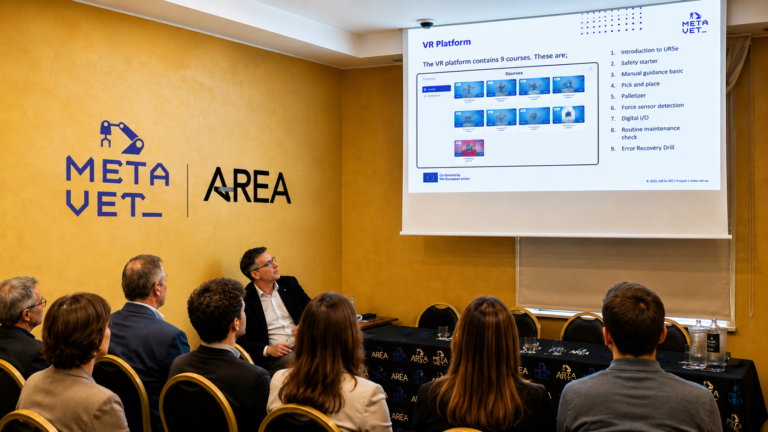
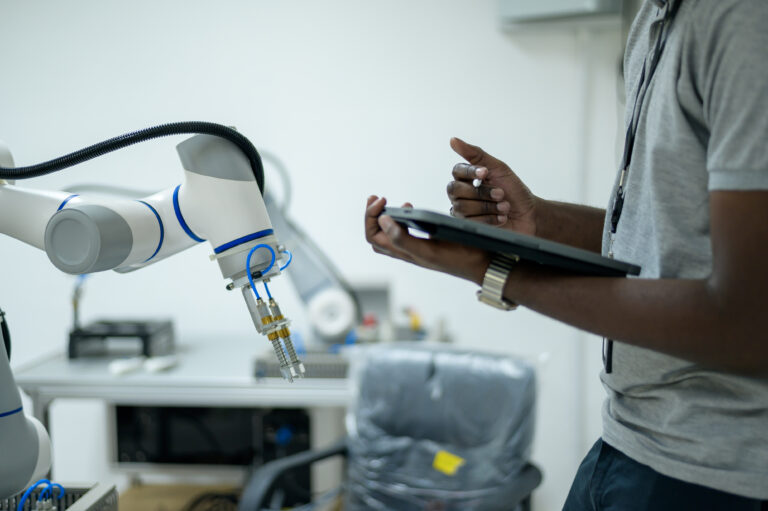
The program opened with a presentation of the MetaVET project under ErasusVET programme, and continued with the concept behind the MetaVET VR platform, which enables students and trainers to simulate real industrial scenarios and interact with collaborative robots (cobots) in a safe, immersive environment. The presentation was followed by a practical demonstration, in which Daniel Schiopu from Multitech Romania presented a UR-3e cobot brought specifically for the event and demonstrated how it can integrate with the MetaVET platform with minimal configuration, highlighting the platform’s flexibility and its ability to provide students with a realistic training environment that mirrors industrial robotics operations.
To kick off the experience, Nicoleta Ciubotaru, Iceberg Plus’s technical expert in VR/AR led the testing session, and a teacher from Technical College Simion Mehedinti courageously volunteered as the first tester. Despite having no prior experience with VR technology, he adapted to the platform, demonstrating its intuitive design and smooth functionality.
Several participating schools tested the platform appreciating the ability to interact with robotic systems in a safe learning environment. They also expressed strong interest in the PC-based version of the platform in addition to the VR version, noting that it could introduce a new dimension to homework and independent practice outside the classroom. The response proves encouraging, as several schools are already planning to begin integrating the platform into their learning environments in the coming days.
Members of the Iceberg Plus team also highlighted potential financing opportunities for schools, emphasizing the importance of diversifying funding sources to support the acquisition of hardware and the development of a modern digital infrastructure for education
One key theme that emerged during the discussions was the growing demand for a qualified workforce in robotics and automation. The need extends both to students currently in training and also to unemployed individuals. Representatives from regional companies discussed possibilities for future partnerships and the development of customized robotics learning setups tailored for local schools. In this context, productive discussions were held with AJOFM Brașov, the public authority responsible for employment services in the region, regarding how digital training tools like MetaVET could support their diverse training programs.
Among other participants were Alexandra Hancu, who leads activities for EIT Urban Mobility in Romania, and Mihai Viseroiu, representing EIT InnoEnergy.
Special thanks to from for supporting the Iceberg team in bringing together such a diverse and influential group of stakeholders from the VET ecosystem. The strong interest shown by participants confirmed that the MetaVET VR platform responds to a real need within the education and training landscape. Diana Ceresmis, the project coordinator from Iceberg demonstrated that, when educational institutions, companies, and public organisations work together, innovative digital solutions can play a powerful role in preparing the workforce of tomorrow.